


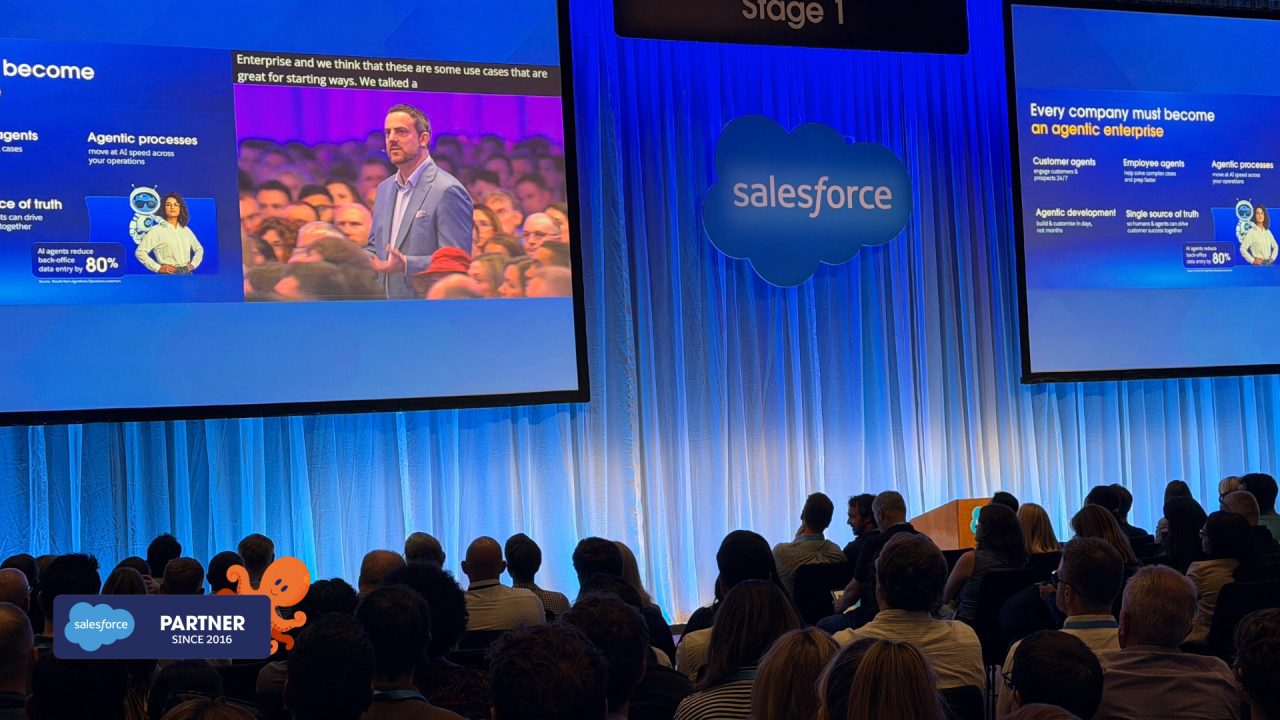
TL;DR: The launch of Headless 360 proved that Salesforce is stepping outside the browser to meet teams wherever they work, effectively transforming the platform from a system of record into an invisible system of execution. Yet, the technical freedom of Headless 360 means nothing without advocacy from the humans using it – making end-user adoption the true bottleneck of AI success.
Ultimately, building a high-performing enterprise requires looking past automated deflection and focusing on the human element. As Zahra Bahrololoumi, CEO of Salesforce UK, stated to Michael McIntyre during the final keynote:
“[AI] cannot replace human connection”
True ROI is not achieved by replacing humans, but by deploying autonomous agents with strict guardrails and trained empathy – like the police agent Bobbi – to absorb simple tasks, thereby freeing human teams to focus on the complex, emotionally charged work that requires genuine connection.
***
The team at Performa are still buzzing (and recovering) from a busy World Tour week in London. Sure, every year is different and exciting for the Salesforce ecosystem, but this year is particularly so, as technology is evolving faster than it has since the mid-20th century, an era when we saw huge innovations such as electricity, cars, antibiotics, indoor plumbing, and flight emerge within the space of decades (Cowen, 2011).
If we sum up the evolution of Salesforce from what was discussed at the event, it would be that the tech has transitioned from a platform you simply log into to an invisible execution layer operating beneath the surface across your digital ecosystem. If implemented correctly, it creates a ‘living’ business where automation happens seamlessly, improving experiences and the day-to-day of its customers and team.
The Latest Update: Headless 360.
For years, getting value out of Salesforce meant putting eyes on a Salesforce screen. The biggest architectural announcement of the keynote completely upends that model: Headless 360, aka, Salesforce anywhere you work.
In a traditional CRM, a user must log in to a browser user interface (UI) to perform their activity. By decoupling the CRM UI and exposing Salesforce’s entire data mesh and business logic via APIs and the Model Context Protocol (MCP), Salesforce is shifting from a system of record to a headless system of execution. To put it in layman’s terms, “Headless” typically refers to separating the front-end (what customers see) from the back-end (where data and logic live), so businesses can build custom experiences while still using Salesforce’s engine underneath.
What does this mean for Salesforce customers?
- True Flexibility. Users now have complete freedom over where they surface Salesforce data. If your team lives in Slack, developer terminals, or custom internal portals, Headless 360 brings the information directly to those surfaces.
- Seamless AI Integration. External coding and text agents can now securely tap directly into the 360-degree customer view without complex, custom-built middleware plumbing.
Solving the Data Problem Upstairs
While Headless 360 unlocks incredible technical flexibility, the live World Tour session “Fewer tools, more growth: How to encourage Sales performance” highlighted a glaring truth: if your people don’t use the system, your AI has no data to learn from.
This is a challenge often brought to Performa by our customers or identified in the discovery phases, and we were glad to see it addressed at World Tour. Many organisations are still struggling with data trapped in silos and legacy systems. But even if you unify that data, AI is only as good as the real-time inputs it receives. High performance isn’t a tech problem; it’s an adoption problem!
To solve the adoption gap, the panel mapped out three core strategies that we at Performa leverage in partnership with our customers that put end-users at the heart of the project from day one:
- Involve End Users Early: Don’t build in a vacuum and drop a new system on teams. Bring end-users into the design phase at the start of a project.
- Prioritise Radical User Experience (UX) Simplicity: Make the system as friction-free and easy to use as possible, so that inputting data doesn’t feel like a chore.
- Align Incentives: Build compensation and commission schemes that actively promote and reward the data-sharing behaviours you want to see.
Top Tips: Moving from Agentforce Pilot to Production
The session “Agentforce in the real world: Lessons and Deployment Plans” provided a highly practical blueprint for organisations looking to move past the “proof of concept” phase of Agentforce implementations. Deploying an agent isn’t a single event; it requires a continuous cycle of real-world iteration…
The Sustainable-Scaling Sequence in Summary:
1. Deploy with a Human-in-the-Loop
Phase 1: “Guardian Gate”.
Launch the agent into production, but insert a mandatory human touchpoint
before the agent allows a user to take any major, consequential action.
2. Monitor, Monitor, Monitor
Phase 2: “Observability”.
Vigorously review the agent’s reasoning paths, conversational accuracy, and escalation triggers against real-world user interactions.
3. Remove the Training Wheels
Phase 3: “Autonomy”.
Once the monitoring data proves the agent has earned a high baseline of trust, safely
remove the human touchpoint to unlock full automation.
As an example, a similar sentiment of mindful scaling was echoed by voice AI provider Natterbox. Building effective AI means retraining customer and user habits. Years of dealing with rigid, frustrating Interactive Voice Response (IVR) setups have conditioned people to yell one-word commands like “HUMAN SUPPORT!” into their phones. Because an advanced conversational agent expects context, rather than single keywords, organisations must deploy simple, transactional tasks first (like password resets). This gradually trains the user and/or customer base to trust that they can speak to the AI in natural language and actually get a resolution.
The Real-World Standout: “Bobbi” and Empathy in Action
Easily the most memorable case study of the tour for us came from the public sector. The Thames Valley Police and Hampshire & Isle of Wight Constabulary shared the real-world impact of Bobbi, the UK’s first police AI agent built on Agentforce.
While Bobbi was strictly designed to handle non-emergency inquiries on the 101 system (like lost property or local advice), the deployment team realised a critical truth about human behaviour: if people are in trouble, they will use whatever digital door is open. Because citizens inevitably use the chat function during active emergencies, Bobbi was intentionally designed with emotional understanding.
The agent can detect distress, show digital empathy, and immediately route critical, high-harm cases to human emergency operators. The true ROI of Bobbi isn’t just about automated deflection; it’s about human optimisation. By automating 45% of everyday, non-emotive tasks, Bobbi removes the “noise,” freeing up human officers to focus their time, empathy, and specialised skills on complex, emotionally charged cases.
Agentforce World Tour 2026 made it clear that success in the agentic era requires a balance of tech and humanity. Winning organisations will be those that use tools like Headless 360 to meet users where they work, build human trust through empathetic design like Bobbi, and support the human teams managing the transformation behind the scenes.
Has any of the latest Salesforce tech piqued your interest? Book a call with our experts today to learn how you can use features such as Headless 360 and Agentforce Voice to win customers, boost productivity and cut costs in your organisation.
References
Chambers, A. (2026) ‘UK’s First Police AI Assistant Handles 200 Chats Per Day’, Technology Magazine, 19 June. Available at: https://technologymagazine.com/news/uks-first-police-ai-assistant-handles-200-chats-per-day [Accessed: 22 June 2026].
Cowen, T. (2011) The Great Stagnation: How America Ate All the Low-Hanging Fruit of Modern History, Got Sick, and Will (Eventually) Feel Better. New York: Dutton.
Ghoshal, A. (2026) ‘Salesforce launches Headless 360 to support agent-first enterprise workflows’, CIO, 16 April. Available at: https://www.cio.com/article/4159536/salesforce-launches-headless-360-to-support-agent-first-enterprise-workflows.html [Accessed: 22 June 2026].
Salesforce (2026) ‘Get to Know Salesforce Headless 360’, Trailhead, April. Available at: https://trailhead.salesforce.com/content/learn/modules/salesforce-headless-360-quick-look/get-to-know-salesforce-headless-360 [Accessed: 22 June 2026].